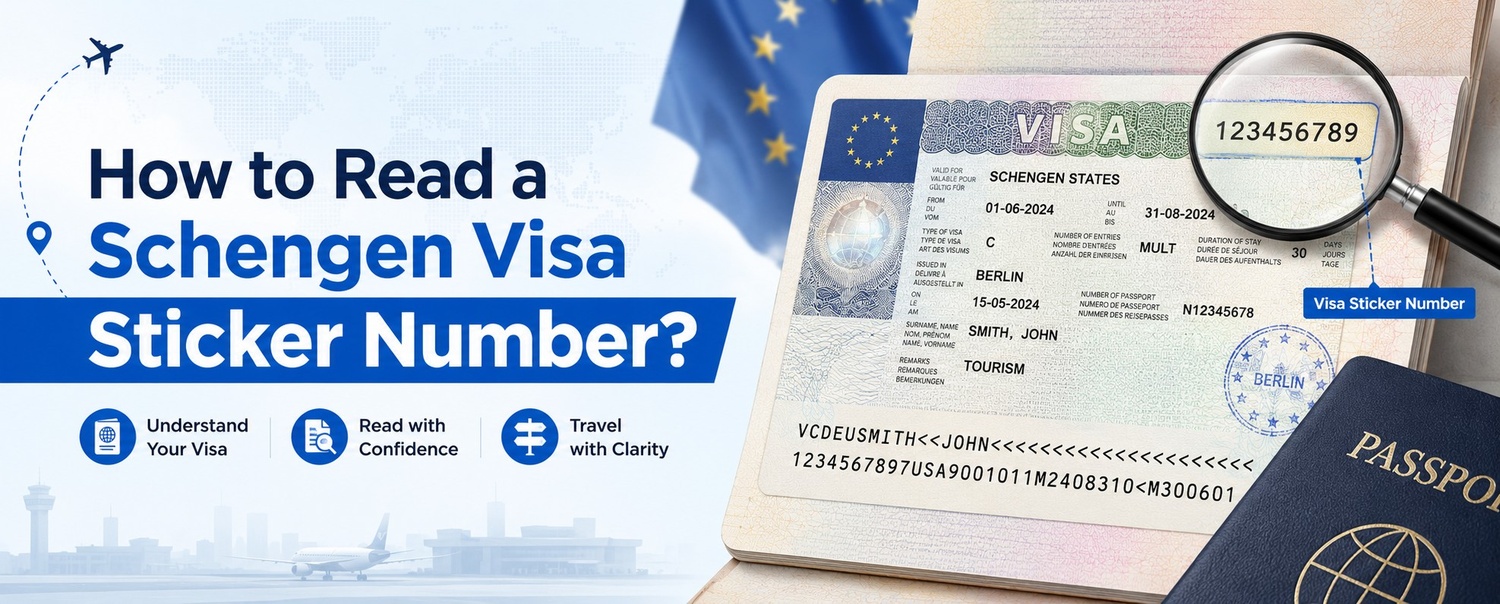
While travelling to the Schengen region, it is crucial to understand the Schengen visa sticker. As it contains the major details of your visa, which include the Schengen visa sticker number, validity, type, and the countries you can visit. So, you must know how to read your visa carefully, as it will allow you to keep track of important travel information.
In the following guide, we will mention how to read a Schengen visa sticker number. Along with how to read the validity, types, and travel rules on your visa. Learning all these details will help you avoid facing the entry issues and travel confidently while complying with the Schengen rules.
Moreover, if you are travelling from the UK and have not acquired your Schengen visa yet, then here you also find a reliable and trustworthy visa partner through which you can apply for your Schengen visa from UK without any worries. So, let’s get started with the blog now!
*We will confirm you through email when the appointment will be fixed.
Before knowing the purpose of a Schengen visa Sticker number, let’s clear out the “what” from your mind. It is basically a unique 9-digit number that is printed in red ink in the upper-right corner of your visa sticker. Here is an example format: 764525356.
The main purpose of the visa sticker number is to allow the immigration authorities and visa processing systems to track and verify your identity. It links your physical passport to the official European database, and the border guards scan this number to verify your visa’s authenticity. Through this sticker number, they can also check your biometric data in the VIS (Visa Information System).
Please note: The Schengen visa sticker number is different from the visa number and application number.
At times, UK travellers get confused between the Schengen visa sticker number and the Schengen visa number. The visa number is used for tracking the visa application, while the sticker number is mainly used for verification of identity at the borders. Here is how you can differentiate between the two:
| Details | Schengen Visa Number | Schengen visa sticker number |
| Format | Bottom of the visa sticker | The top right corner of the visa sticker |
| Location | Alphanumeric format (e.g., RTQ2345967) | 9-digit number (e.g., 764525356) |
| Purpose | To track the visa application in the consulate database | To identify and track your identity at the Schengen borders |
Did you know? The visa sticker is provided in three languages: English, French, and German. However, you may find your local language used in the specific travel conditions or restrictions in the “Remarks” section.
A Schengen visa serves as an official permit that allows UK travellers to visit all 29 Schengen countries. It means with a single Schengen visa, you can travel to all the countries of the Schengen zone, according to the common Schengen visa policy. However, the visa remains valid for a particular time during which you can enter and travel in the Schengen region.
A visa sticker plays a major role in ensuring that you can visit any Schengen country on a single Schengen visa.
The section “VALID FOR,” “VALABLE POUR,” and “GULTIG FUR” on the visa sticker lists the Schengen countries you can visit. For example, if it is written “ETATS SCHENGEN” or “SCHENGEN STATES,” then it means that the visa is valid in all the Schengen countries, and you can travel with your single Schengen visa throughout the region within a specific time frame.
If your visa is restricted to certain countries, the initials of the permitted countries will be abbreviated on it. For example, displaying “CH, D, IS, N, B, F, P” means that your visa will only remain valid in Switzerland, Denmark, Iceland, Norway, Belgium, France, and Portugal. If only a single country’s name is written, you will be allowed to enter only that Schengen country.
Here is the complete abbreviation list of the 29 Schengen countries:
| Country | Code |
| Austria | A |
| Belgium | B |
| Bulgaria | BG |
| Croatia | HR |
| Czech Republic | CZ |
| Denmark | DK |
| Estonia | EE |
| Finland | FIN |
| France | F |
| Germany | D |
| Greece | GR |
| Hungary | H |
| Iceland | IS |
| Italy | I |
| Latvia | LV |
| Liechtenstein | FL |
| Lithuania | LT |
| Luxembourg | L |
| Malta | M |
| Netherlands | NL |
| Norway | N |
| Poland | PL |
| Portugal | P |
| Romania | RO |
| Slovakia | SK |
| Slovenia | SLO |
| Spain | E |
| Sweden | S |
| Switzerland | CH |
If your visa sticker contains «ETATS SCHENGEN (-country initial)», then the visa is valid for all Schengen countries, except for the country that is written after the hyphen. For example, if the label is «ETATS SCHENGEN (-PL),” then you will be able to visit all the Schengen countries except Poland.
On your Schengen visa sticker, the validity dates are printed. It indicated how long you can stay in the Schengen area.
Valid From Date: The labels “FROM,” “DU,” or “VOM” indicate the first day you are permitted to enter the Schengen Area.
Valid Until Date: The labels “UNTIL,” “AU,” or “BIS” show the last day you can stay in the Schengen Area.
Duration of Stay: This is the maximum number of days that you can stay in the Schengen area within the validity period of the visa. It is labelled as “DURATION OF STAY,” “DUREE DE SEJOUR,” or “TAGE.”
The visa type on your Schengen visa sticker mainly determines the purpose of your travel and the duration of your stay. On your visa sticker, it is usually marked as A, C, or D under the labels of “TYPE OF VISA,” TYPE DE VISA,” and “VISA TYP.”
Label “A”: It means a Type A visa, which is known as an Airport Transit Visa. It allows UK travellers to transit through a Schengen country’s airport on their way to a non-Schengen country.
Label “C”: It means a Type C visa, which is known as a short-stay visa. It allows UK travellers to enter and stay in the Schengen region for up to 90 days within a 180-day period.
Label “D”: It means a Type D national visa, which is known as a long-stay visa. It allows UK travellers to enter and stay in the Schengen region for more than 90 days.
If you are still confused about the type of visa or have questions about your eligibility, you can CONTACT our experts. They remain available 24/7 so you can reach out to them anytime!
You will find the number of times you are allowed to enter and exit the Schengen region under the label “NUMBER OF ENTRIES,” “NOMBRE D’ENTREES,” or “ANZAHL DER EINREISEN.”
The issuance date of your visa is the date when the visa centre grants it. The issuance date is printed above the Schengen visa sticker number. It will be present in the format of DD-MM-YYYY.
The details of the visa holder are printed in multiple places on the visa sticker. Here is how you can find them:
| Labels | Details |
| “NUMBER OF PASSPORT,” “NUMERO DE PASSEPORT,” and “NUMMER DES PASSES” | Shows the number of passports. |
| “SURNAME, NAME,” “NOM, PRENOM,” and “NAME, VORNAME” | First name followed by family name. |
| “REMARKS,” “REMARQUES,” or “BEMERKUNGEN” | Represent the purpose of your travel to the Schengen area, such as work, tourism, or family reunification reasons. |
| NATIONALITY | Represents the visa holder’s nationality |
If you have not got the Schengen visa yet and are planning to apply for your Schengen visa appointment London, Manchester, Edinburgh, or anywhere in the UK, follow the steps provided by the SCHENGEN VISA HELP experts.
1. Duly fill out the Online Schengen visa application form. Submit it after paying the nominal service charges.
2. Our visa experts will contact you to ask about your travel dates. Based on that, they will book your visa appointment slot in just 2-3 working days.
3. After the successful booking, you will be required to visit the visa centre for the verification of your visa documents. Visa officials will also register your biometric details.
4. Lastly, your Schengen visa UK will be processed within 10 to 15 working days.
| Our UK Client’s Experience with SCHENGEN VISA HELP Professionals! Oliver, one of our UK applicants, has had his flights booked for Germany in the next 40 days. But due to peak travel season, he was facing a delay in the appointment booking. That’s when he reached out to our experts. After submitting the online visa application successfully, our experts booked his appointment slot within 2 days. Along with that, they also helped him get his visa documents sorted according to the standard Schengen rules. Without any further issues, he got his visa approved within 20 working days. That’s what he wrote to us- Thanks, guys, for making my visa process for Germany so smooth. I never thought it could be this simple to get a Schengen visa. I agree, the right guidance and support can really make things much easier! |
You may also like: How to Avoid Schengen Visa Delays During Peak Travel Seasons!
In conclusion, after reading the above detailed guide, we hope that you have understood how to read the Schengen visa sticker number. Additionally, we have explained the complete Schengen visa sticker in detail above.
Undoubtedly, the Schengen region is beautiful and attracts millions of UK travellers every year. So, if you are also planning to visit any Schengen country and have not got the visa yet, then make sure to APPLY 3 months before your travel dates. Happy travel!
*We will confirm you through email when the appointment will be fixed.
Usually, the processing time of a Schengen visa is around 10 to 15 working days. However, during peak travel seasons, visa centres face a huge number of visa application submissions, which leads to delays in the visa process. As a result, the processing time may take up to 45 days. That is why it is always suggested to apply for your Schengen visa at least 3 months before your travel dates.
Yes, you will be needing this 9-digit number while filling out the Passenger Locator forms. It can also be required while booking intra-Schengen travel or for showing to the local border authorities. Mainly, it is required to verify the authenticity of your visa.
If your personal details, such as your name or passport number, are incorrect, you must contact the visa-issuing centre immediately. It is important to get the error rectified before you depart from the UK.
Yes, the border guards will use this number with your fingerprints in the visa information system (VIS). This number is mainly used to process your entry at the external borders.

 7300-463-745
 02084-323-472