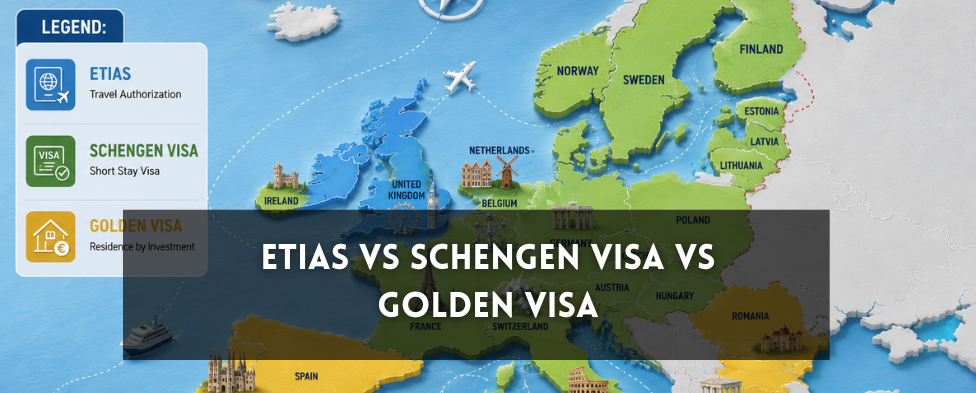
Are you planning your trip to a Schengen country? Then you may not or may require a visa if you are a non-EU traveller. When planning a trip to Europe, understanding the requirements for entry is necessary. While navigating the process for visa for non EU travellers and other travel requirements, you might encounter a few terms, including the Schengen visa, ETIAS (European Travel Information and Authorization System), and the Golden visa.
Often, travellers find them similar, but they aren’t and serve different purposes. If you are confused with them too and unable to understand which one you actually need for your Schengen trip in 2026, then this guide is for you.
Here’s a detailed breakdown of the differences between these permits to help you understand which one applies to your travel plans.
*We will confirm you through email when the appointment will be fixed.
A Schengen visa is a permit that allows travellers to visit the Schengen region and stay there for a specific period of time. This visa is categorized into two parts: short stay and long stay!
A Schengen Visa is a short-term visa that allows non-EU nationals to travel to the Schengen countries and stay for up to 90 days within a 180-day period. This visa is used primarily for tourism, business, or family visits. Whereas the long-stay visa allows a stay for more than 90 days.
Non-EU travellers who are legally residing in the UK might require Schengen visa from UK. This depends on their nationality, and if they belong to a country that does not have any visa-free agreement with the Schengen area, then they need to book a Schengen visa appointment.
| Feature | Description |
| Type | Short-stay Schengen visa (Type C) |
| Validity | Usually issued for single, double, or multiple entries, depending on travel history |
| Purpose | Tourism, business, family visit, medical, or short study trips |
| Stay duration | Up to 90 days within a 180 day period |
| Applies to | UK residents holding eligible non-UK passports and valid UK residence permits |
| Processing time | Standard processing time is 10-15 working days |
| Travel area | Valid across 29 Schengen countries |
ETIAS is a new travel authorisation system that is in the process of implementation and expected to start in the last quarter of 2026. This will be required by nationals from over 60 visa-exempt countries, including the United States, the UK, and Canada, to visit Schengen countries for a short stay.
The ETIAS was introduced under the framework of EU Regulation (EU) 2018/1240 to improve border safety, and it will be linked to a traveler’s passport and will be valid for three years after registering for travel authorization.
| Feature | Description |
|---|---|
| Type | Electronic Travel Authorisation (Not VISA) |
| Validity | 3 years or until the passport expire |
| Cost | €20 |
| Purpose | Tourism, business, or transit |
| Stay duration | Upto 90 days within 180-day peirod |
The Schengen visa and ETIAS are something that often confuses travellers. These permits differ based on their requirements and the applicant. A Schengen visa is required by non-EU travellers who are not included under a visa-free agreement, while an ETIAS is required by nationals of countries having a visa-free agreement with the Schengen region.
Also, a Schengen visa is an in-person process that requires the applicant to visit the visa centre, whereas ETIAS is an online process. UK applicants have to get the Schengen visa appointment three months before their travel dates to get the visa processed in a timely manner.
The European Travel Information and authorisation system (ETIAS) is a pre-travel electronic system that allows visa-exempt travellers to enter the Schengen region without a visa. This is a digital authorisation attached to the passport, and it will be required while crossing borders. This authorisation is not a VISA and is different from the Golden visa.
A golden visa is a residency-by-investment program that is offered by Schengen countries or European countries. This visa gives long-term residency to the holder in that country.
Schengen countries, including Portugal, Greece, and Spain, offer this program and attract investors through different routes like real estate purchases, capital fund contributions, etc. Remember that Golden Visa programs follow a two-stage structure. You first receive a residency permit, then become eligible to apply for permanent residency or citizenship after meeting the program’s minimum requirements over several years.
ETIAS only permits you to enter the country and does not give residency rights, work rights, etc. A Golden visa is a national residency instrument.
| Feature | ETIAS | Golden Visa |
|---|---|---|
| Legal nature | Travel authorisation | Residency permit |
| Right to work | NO | Depends on national rules |
| Issued by | EU-wide system | Individual country |
| Stay | Up to 90 days within 180-day period | Long-term, country-specific |
| Right to estate | NO | Yes |
The ETIAS process is completely online, and you can get it done on the official website or the ETIAS mobile app. The only official ETIAS website is hosted by the European Union at travel-europe.europa.eu/etias. There is no requirement for appointment booking. To apply, you must have some documents, including a Valid travel document, payment card to cover the €20 fee, and other details about your occupation and education level.
Most applications are processed within minutes. And in case of additional verifications, it can take up to 4 days.
Recommended Time to Apply Once It Starts
You may also like: Schengen Visa Itinerary Sample: Free Travel Plan Templates
Visa categories vary as per the travel purpose, duration of stay, and number of entries. Travellers apply for short-stay as well as long-stay visa according to their intended duration of stay.
Short-stay visa (Type A and C)
Also known as Uniform Schengen visa, which includes a Type A (Airport transit visa) and a Type C (short stay) visa, which applies to stays of up to 90 days within any 180-day period.
Type A is for travelers transiting through Schengen airports, and Type C is for short visits (of up to 90 days) to the Schengen — such as for tourism or business.
Long stay (Type D)
If you’re planning to stay in a particular Schengen country for more than 90 days, you’ll have to opt for a Type D (long stay or national) visa. This visa is required for purposes such as work, training programs, internships, school, family reunification, and so on.
A Schengen visa from the UK is a permit that allows UK travellers to legally visit the region and stay there for specific short or long periods. The travellers are advised to apply three months before their travel date.
Are you finding a trusted visa agency in UK, where you can get a quick Schengen visa appointment? SCHENGEN VISA HELP is one of the most reliable visa platforms, which is trusted by thousands of UK applicants for their Schengen visa services. Follow their efficient and fast process to get Schengen visa in just two weeks!
Applications are handled by visa application centres in London, Manchester, and Edinburgh.
Processing time: Around 10–15 working days. During peak season, this can extend a month or even 45 working days.
Schengen visa application: Filled & signed visa application form
UK residence proof: Submit a residence permit (original as well as copy), like a UK eVisa/share code, and it should be valid for 3 months beyond departure.
Passport: Original, valid, and signed passport issued within the last 10 years, and it should be valid for 3 months beyond departure.
Recent Photographs: Submit two recent photographs (4.5 cm X 3.5 cm) taken on a light (white or off-white) background. The photos must not be older than 6 months.
Accommodation proofs: Submit the proof of your stay, like a hotel reservation. Submit an invitation letter if staying with the host.
Financial proofs: Submit the bank statements of the last 3-6 months, which show that you have sufficient funds to live in the country.
Travel insurance: Submit the insurance with a minimum coverage of EUR 30,000.
Experts at SCHENGEN VISA HELP have years of experience in handling these visa services and know the detailed documentation. So, to avoid any rejection or documentation errors, you can get professional assistance anytime.
Visa categories vary as per the travel purpose, and submitting the form with the wrong one can result in the rejection of your application immediately.
As per Schengen rules, travelers can apply for a Schengen visa up to 6 months before their intended travel dates, but no later than 15 days before.
Documents are an essential part of every visa processing, and as per the Schengen standards, you must arrange the paperwork to submit at the visa centre. Before submitting, make sure to arrange every mandatory document and check its validity.
Make sure to put every detail asked for in the application form and avoid making errors. Put in the true information, and before submission, cross-check every piece of information.
Make sure you have strong finances and you submit the necessary financial documents at the visa centre.
Getting the slot is difficult, especially during peak season and high application times. Our experts can schedule your express Schengen visa appointment within two days.
You may also like: Is Austria expensive? Cost of Living in Austria
In conclusion, if you are planning a trip to a Schengen country or EU countries, then you might have come across the new travel requirements, including ETIAS, and EES. With these new requirements rolling out, many travellers are confused about whether they need Schengen visa, ETIAS or other visa categories like the Golden visa.
This comprehensive visa guide breaks down the travel system to help the travelers determine which one suits their travel plans. So before booking your flight tickets and getting the accommodation done, always verify whether your nationality requires a visa or other travel authorization like ETIAS. Planning ahead is always necessary to make your trip effortless and stress-free.
*We will confirm you through email when the appointment will be fixed.
NO, ETIAS is a travel authorization, not a visa. ETIAS is only required by travellers who are from visa-exempt countries, whereas Schengen visa is required by the non-EU travellers who are not from visa-exempt countries.
In case of refusal, you can reapply for Schengen visa or appeal against the decision. The reasons for the refusal involve mistakes and imprecision on the form you filled out and missing or invalid supporting documents. An appeal is a long-term jurisdictional process against the rejection.
Yes. Children and infants need to apply for ETIAS, regardless of age. However, travellers under 18 do not have to pay the €20 fee.
The processing time for a Schengen visa is approx. 15 working days from the date the application is received by the visa centre.

 7300-463-745
 02084-323-472